
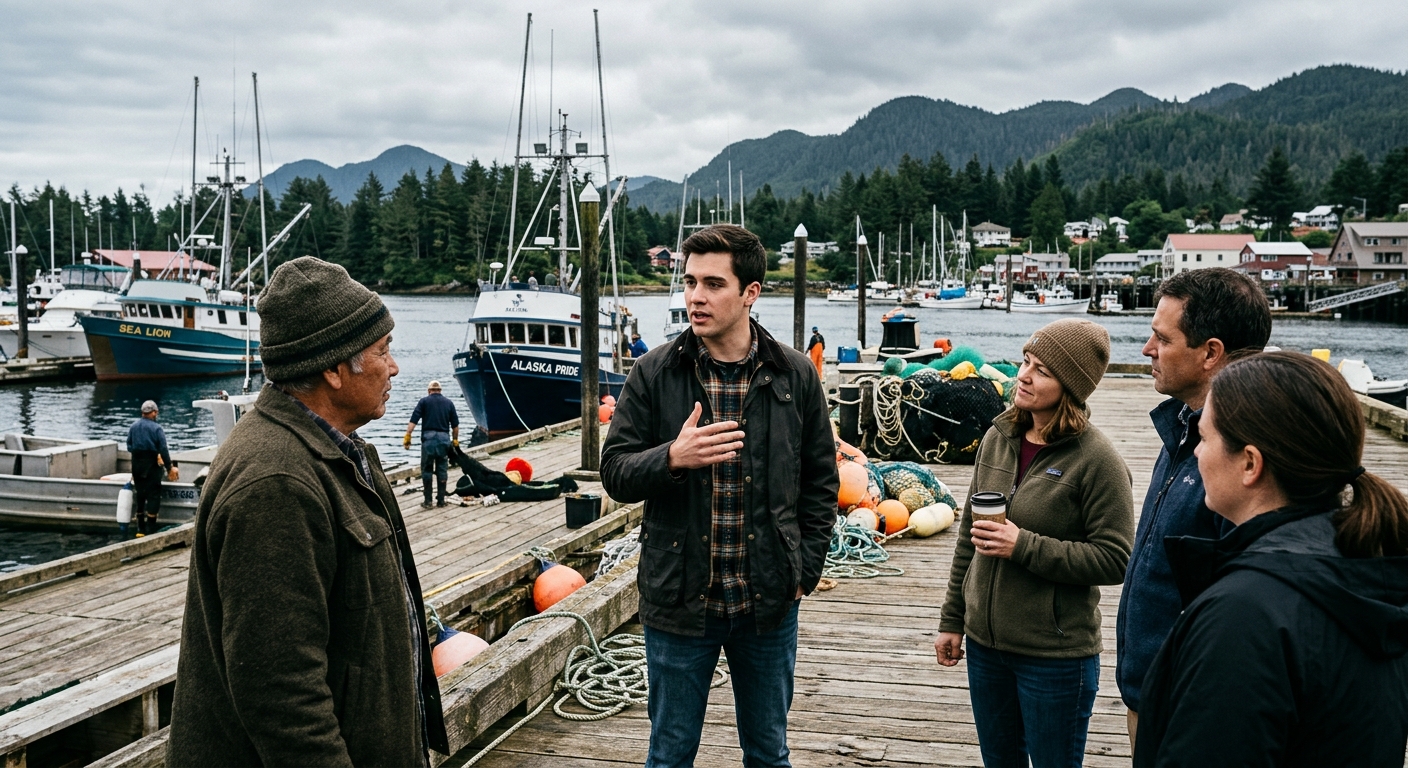
AI-generated illustration; not a photograph of the reported event.
- calendar_today October 22, 2026
Jonathan Kreiss-Tomkins: Charting a New Course in Alaska Politics
Jonathan Kreiss-Tomkins, a moderate Democrat with a reputation for intense dedication, stands on the verge of becoming Alaska’s first Democratic governor in a generation—and possibly its youngest. Known across the state simply as JKT, his trajectory from childhood political organizer to gubernatorial frontrunner is already considered legendary in Alaska political circles.
An Early Introduction to Politics and Adventure
Kreiss-Tomkins’ engagement with politics began at age 13, when he became a state organizer for Howard Dean’s presidential campaign, hiding his age through the internet. He is also a mountaineer, classical cellist, and ultramarathon runner. After dropping out of Yale University, he won a legislative seat at age 23, forging a decade-long career in the Alaska legislature building bipartisan coalitions—even conducting legislative business on his phone while training in Juneau’s hills. A paragliding accident later slowed him only slightly, despite two broken bones in his right leg.
Roots in Sitka and a Distinct Approach to Alaska Politics
Hailing from the island town of Sitka—a community of 8,000 known for its isolation and diverse heritage—Kreiss-Tomkins is well-acquainted with the insular, close-knit nature of Alaskan society. Local leaders like Alana Peterson, a Sitka tribal leader, note that reputations travel fast in such a small town. Raised by a tribal health doctor and a commercial fisherman, Kreiss-Tomkins describes his upbringing as ‘feral,’ bonding with Alaska’s land and people as he learned to navigate its challenges from a young age.
Central Campaign Themes: Coalition Building and State Priorities
Kreiss-Tomkins’ record in the Alaska legislature is characterized by bipartisan coalition-building. He was instrumental in passing legislation to recognize Alaska’s 20 Indigenous languages as official state languages, protecting the Permanent Fund—which finances state government and annual dividends—against overspending, expanding voting by mail, and making it easier to hire Indigenous language teachers. His campaign for governor is based on strengthening public schools, ensuring Alaska fisheries support Alaska fishermen, stabilizing state finances, and lowering energy costs through a mix of oil, gas, and renewable energy sources.
A Contentious Race and Republican Divisions
The race for Alaska governor features three main Republican opponents and a divided Republican party. Bernadette Wilson, Kreiss-Tomkins’ chief Republican rival, has criticized him as a ‘radical’ and claimed he is beholden to out-of-state interests, highlighting large campaign contributions from Anthropic employees and other non-Alaskans. However, Kreiss-Tomkins asserts that he set a record collecting donations from 3,500 individual Alaskans, even as 70% of his $4.3 million campaign fund came from outside the state.
Infighting among Republicans—including pleas from Wilson and former president Donald Trump for party unity—contrasts with the Democratic camp, where former contender Tom Begich dropped out of the race to endorse Kreiss-Tomkins. Notably, Kreiss-Tomkins is supported by a broad range of leaders: Alaska Native leaders, commercial fishermen, police unions, and prominent Republicans.
Facing Alaska’s Future: Problems and Promises
Alaska’s next governor will face significant challenges: persistent budget shortfalls, closed schools, rural energy crises, a shrinking population, the threat of blackouts, and economic instability tied to oil prices. Kreiss-Tomkins draws comparisons between the state’s current crossroads and formative eras like early statehood or the construction of the Trans-Alaska Pipeline. With a message focused on returning to a time of proactive problem-solving and optimism, Kreiss-Tomkins positions himself as a unifying candidate ready to tackle Alaska’s unique challenges.
As he prepares for a potential victory, Kreiss-Tomkins has pledged to form a politically balanced Cabinet and insists his ambitions are Alaska-focused. His campaign, fueled by legendary energy—and a fondness for late-night Russian dumplings shared with friends—reflects a vision grounded in local values and broad coalition-building. With independents making up more than 60% of Alaska’s electorate, the outcome of the Alaska election may hinge on whether his centrist, pragmatic approach can bridge the state’s deep partisan divides.
Source: juneauempire.com.


