
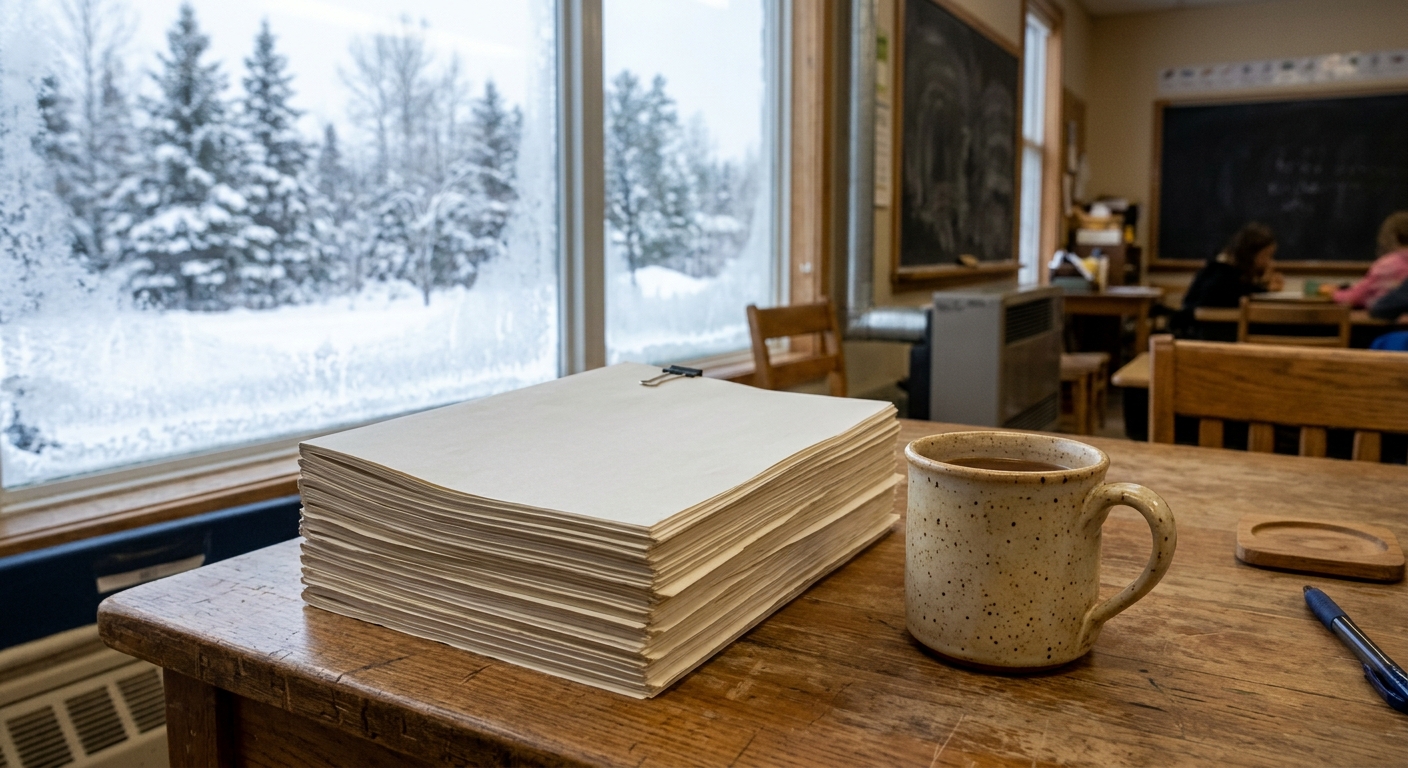
AI-generated illustration; not a photograph of the reported event.
- calendar_today November 12, 2026
Legislative Task Force Releases Draft Report on Education Funding
An Alaska legislative task force, established to analyze the future of public school funding, has released a draft report calling for a comprehensive, independent study of the state’s funding formula. The Legislature’s Task Force on Education Funding produced a nine-page document outlining its preliminary recommendations, seeking public input before issuing a final report.
Focus on Defining an Adequate Education
Rather than recommending specific increases or formula changes to education funding, the report starts by defining what constitutes an “adequate education” as required by the state Constitution. The document emphasizes key elements such as safe learning environments, qualified teachers, well-maintained facilities, opportunities for extracurricular activities, and coursework aligned with state standards. Data from the 2024-2025 school year shows roughly a third of Alaska students met grade-level proficiency in English, math, and science.
Recommendation for an Independent Adequacy Study
A central recommendation from the task force is to conduct an independent “adequacy study” of the state’s education funding formula. Sen. Löki Tobin, an Anchorage Democrat and co-chair of the task force, stated that the study would help determine whether current funding enables students to meet proficiency standards. The draft report urges lawmakers to allocate $500,000 to contract national experts, working alongside the University of Alaska Anchorage’s Institute of Social and Economic Research, to perform this study. An earlier attempt to fund such a study with $400,000 was vetoed by Governor Mike Dunleavy.
Additional Recommendations and Points of Contention
The document includes recommendations to establish a separate funding formula for school maintenance and review the process for state repairs and upgrades. It calls for continued financing of a newly launched energy relief program for schools and supports legislation to average student enrollment counts over three years to provide budgeting stability.
Not all members of the six-person task force agreed with the draft recommendations. Rep. Justin Ruffridge, a Soldotna Republican and one of two minority members on the task force, expressed concerns about delaying formula changes until after a study is completed. He argued for reassessing and rebuilding the funding formula with close attention to how dollars are used, particularly favoring smaller class sizes and better-maintained facilities. Ruffridge also disagreed with the report’s assertion that in-person learning “significantly outperforms” online learning for most students, advocating for equitable consideration of all educational options in Alaska.
Discussion of Open Enrollment Policies
The task force’s draft report does not make specific recommendations regarding open enrollment—the process allowing students to attend schools outside their home districts. While open enrollment was among the issues the panel was asked to study, the report notes that existing state rules permit such practices, subject to capacity and tuition regulations. Sen. Tobin stated that the current system appears adequate.
Next Steps and Public Feedback
The task force plans to solicit public comments during a scheduled ten-hour hearing. The group aims to revise and finalize its recommendations before the new legislative session begins in January.
Source: ktoo.org.


