- calendar_today August 15, 2025
Species Could’ve Been Smarter—But That’s Not Why It Endures
Michael Madsen, who passed away earlier this month, was an actor who left an indelible mark on Hollywood, known for his roles in movies like Reservoir Dogs, Kill Bill, and Donnie Brasco. While his extensive filmography is filled with memorable parts, one role that hasn’t received as much attention since his passing is his performance in the 1995 sci-fi thriller Species. As this year marks the film’s 30th anniversary, it’s worth taking a look back at Species, a wild, audacious movie in an era when monster movies were everywhere, and everyone was feeling extra paranoid about aliens.
Species 1995
Directed by Roger Donaldson (No Way Out, The Bounty), Species took a strange approach to soft sci-fi. The film starts when the U.S. government intercepts two transmissions from outer space. One is a detailed blueprint for a new fuel source. The other is specific instructions for how to splice alien DNA and human DNA. What happens next is fairly predictable: The government takes the bait. With Dr. Xavier Fitch (Ben Kingsley) in charge, a new hybrid is formed: Sil, played by Michelle Williams in her youth. The government assumed that the experiment would create an unthreatening organism that would be easy to control. But as it turns out, they were wrong.
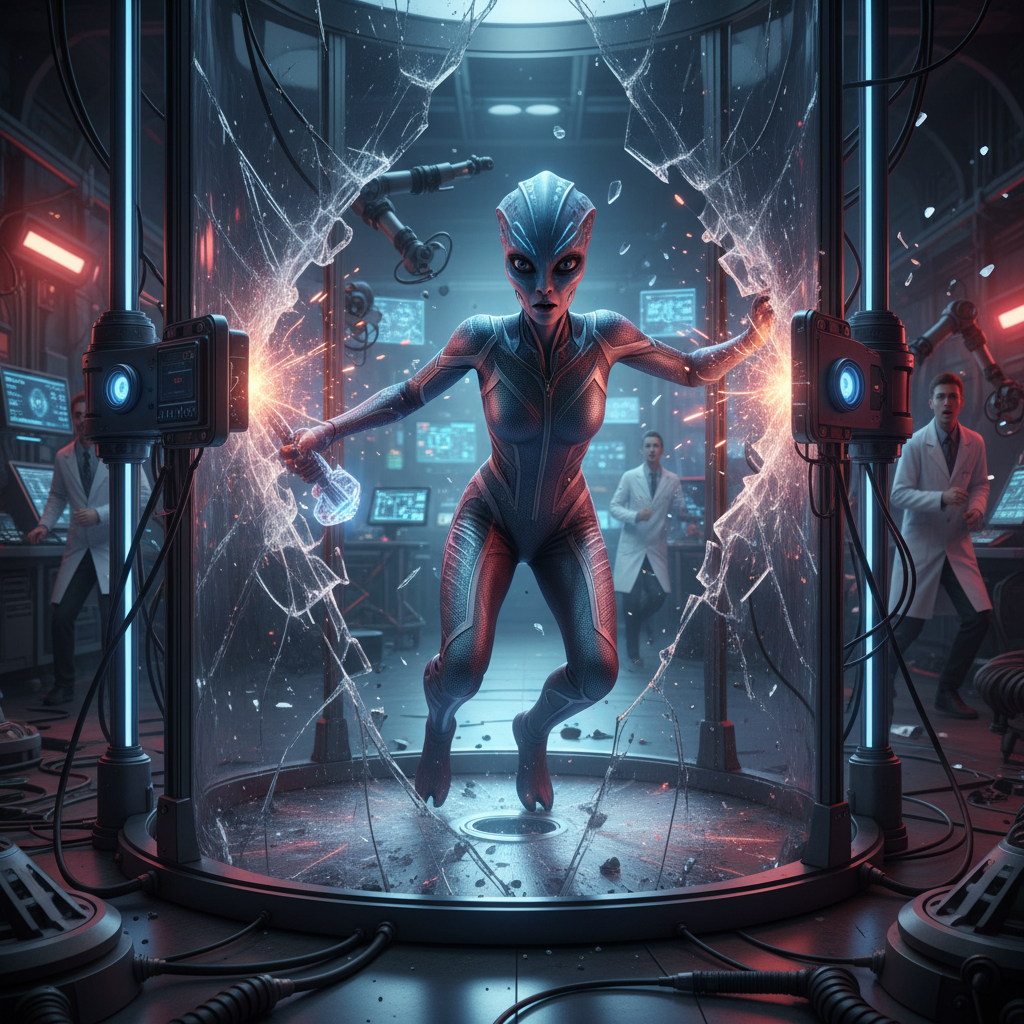
The half-alien/half-human quickly develops, reaching the appearance of a 12-year-old in just three months. But something is a little off. She has violent nightmares, and indications start to show that she may not be as “controllable” as the government assumed. Fitch decides to kill the experiment by releasing cyanide into her containment cell, but Sil escapes, and it’s go time.
To find her, Fitch and others form a team of specialists to hunt her down, which includes Madsen’s Preston Lennox, a taciturn mercenary; Dr. Laura Baker (Marg Helgenberger), a molecular biologist; Dr. Stephen Arden (Alfred Molina), an anthropologist; and Dan Smithson (Forest Whitaker), an enigmatic empath with the psychic ability to understand what Sil is thinking. The team chases her across the country, ending up in Los Angeles, where she starts actively trying to find a human to mate with and reproduce. She’s smart, resourceful, and easily manipulated by instinct. As the body count rises (first a train tramp, then a nightclub victim, then a doomed lover), the group struggles to get ahead of her before she creates more offspring that could potentially reproduce just as rapidly.
Species 1995
The creature in Species was one of the film’s most enticing elements, developed by special effects legend H.R. Giger (best known for designing the xenomorph from Alien). The most important element for Giger was that Sil be “an aesthetic warrior, also sensual and deadly.” His designs for her were unique: The finished version of Sil was described as having translucent skin “like a glass body but with carbon inside.” Giger had envisioned multiple stages of alien evolution in his original design for Sil, but had to simplify his approach due to production constraints. He made do with a stage of transformation cocoon and a maternal alien body for the movie’s third act.
Giger wasn’t thrilled about the finished film, in large part because he felt it bore too many similarities to his previous work on Alien, from the “punching tongue” to the legendary birth sequence, which he felt was a poor man’s version of the “chestburster” from the original. He even made a special request to the producers during filming that Sil be killed by a bullet to the head in the third act (and not by flame-throwers, as had been written in the script), because he said it looked too similar to both Alien 3 and Terminator 2.
Species 1995
For all its inventive design, Species wasn’t a huge critical success. The script by Gerald Di Pego (Rio Heat) had some shtick to it, and a lot of the characters were thinly drawn. Kingsley as Fitch is morally ambiguous and a bit of a dud, while Whitaker as the empath sort of hovers in the background while making expository points. The concepts at the heart of Species (bioethics, alien contact, maternal instinct) all went unexplored to some degree, despite the ominous posturing in the first act. What’s weird is that while it can be deeply silly, Species is also fascinating for the film’s patchwork attempt to blend sci-fi and erotic horror. The inspiration for Feldman’s script came from a 1973 article by Arthur C. Clarke, in which he argued that aliens were never likely to visit Earth because of the low likelihood of FTL (faster-than-light) travel. But what if, Feldman asked, aliens did make contact with Earth by sending blueprints to create something organic rather than metal—a parasitic, sentient species that could grow, created out of Earth’s DNA?
It all came together in the resulting film, which served as both a cautionary tale about human arrogance and a traditional creature feature. Species may not ever join the ranks of Alien or The Terminator, but the movie has earned a place in cult-movie history—and for good reason. From Henstridge’s ethereal performance to Madsen’s grizzled one to Giger’s unforgettable design, Species remains an irresistible ’90s sci-fi curiosity.
Species 1995
Three decades later, Species is a time capsule for science fiction when style often won out over substance—and the unforgettable roles that helped make actors like Michael Madsen stars along the way.