- calendar_today August 10, 2025
Saving the surreal: MJT staff work tirelessly post-fire
LA’s Museum of Jurassic Technology (MJT) suffered significant damage during a nighttime fire earlier this month. The July 8 fire destroyed the museum’s gift shop and caused extensive smoke damage to many other exhibits. The museum estimates its lost revenue during the building’s closure to be $75,000. It hopes to reopen later next month.
The MJT has held a unique but revered place in LA’s cultural scene for decades. The museum was established in 1988 by David Hildebrand Wilson and Diana Drake Wilson. It is known for its cryptic and sometimes questionable exhibits. The museum advertises itself as being “dedicated to the advancement of knowledge and the public appreciation of the Lower Jurassic.” But it has very little to do with the Lower Jurassic. It is more inspired by the cabinets of curiosity or wunderkammers of the Renaissance, which were an early form of museums.
Over the decades, the museum has established a following for its distinct and often multilayered narratives. Some exhibits display legitimate historical pieces, but in others, the lines between fact and fiction are blurred to the point where many visitors can’t be sure what’s true and what’s not. One permanent exhibit highlights the achievements of 17th-century polymath and Jesuit priest Athanasius Kircher. Another feature is the tiny sculptures of Armenian artist Hagop Sandaldjian, which are displayed inside the eye of a needle and made from a single human hair.
The other exhibits at the MJT are even more outlandish. One is a display of rotting dice from celebrated magician Ricky Jay. Another called “The Garden of Eden on Wheels” is a visual history of the trailer parks of the Los Angeles area. It also contains stereographic radiographs of flowers, microscopic mosaics made from butterfly wing scales, and a collection of strange letters written by amateur astronomers to the Mount Wilson Observatory between 1915 and 1935. Since 2005, it has also included a Russian tea room based on Tsar Nicholas II’s study in the Winter Palace of St. Petersburg.
Firefight and Aftermath
Writer Lawrence Weschler, whose 1996 book Mr. Wilson’s Cabinet of Wonder delves into the origins of many of MJT’s exhibits, published a thorough account of the fire. The fire was discovered by David Wilson, the museum’s co-founder. He resides in a home behind the museum and noticed the flames. “A ferocious column of flame” is how Wilson later described what he saw, the flames climbing up the corner wall on the street-facing side of the building.
Armed with two fire extinguishers, Wilson ran out of his home and toward the building. But upon arrival, he found that the extinguishers he had were no match for the scale of the fire. But his daughter and son-in-law had just arrived, and they arrived with a much larger extinguisher. They were able to extinguish the fire just before firefighters arrived on the scene. Wilson was told later that had the firefighters arrived one minute later, the entire building would likely have been lost.
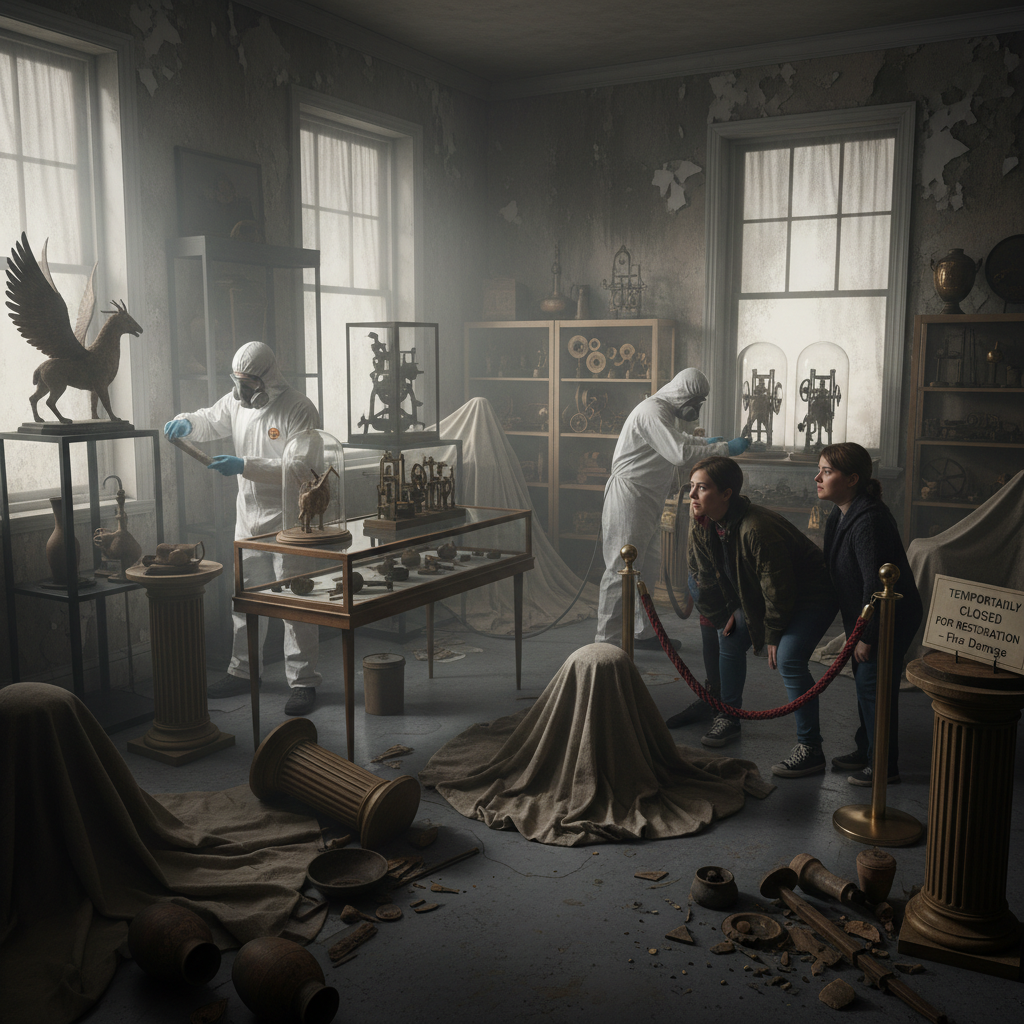
Structural damage was confined to the gift shop, but the smoke damage spread throughout the museum. Wilson later described it as being like “a thin creamy brown liquid… evenly poured over all the surfaces—the walls, the vitrines, the ceiling, the carpets, and eyepieces, everything.” Smoke damage of that sort can be incredibly difficult to remove, especially for a facility as concerned with presentation and detail as MJT. The museum’s staff and volunteers have been working continuously to clean and repair the affected areas, a process which is described as slow and backbreaking.
In the meantime, Weschler has asked those who support the museum to donate to the general fund to help make up some of its losses and cover repair costs. In his statement, Weschler called MJT “one of the most truly sublime institutions in the country,” a place that “eschews all our ordinary ways of defining what science is and what art is and what a narrative is.”
No official reopening date has been set. The museum will likely have no trouble recovering from this setback, its blend of satire, scholarship, and surrealism proving as indestructible as it has always been.