
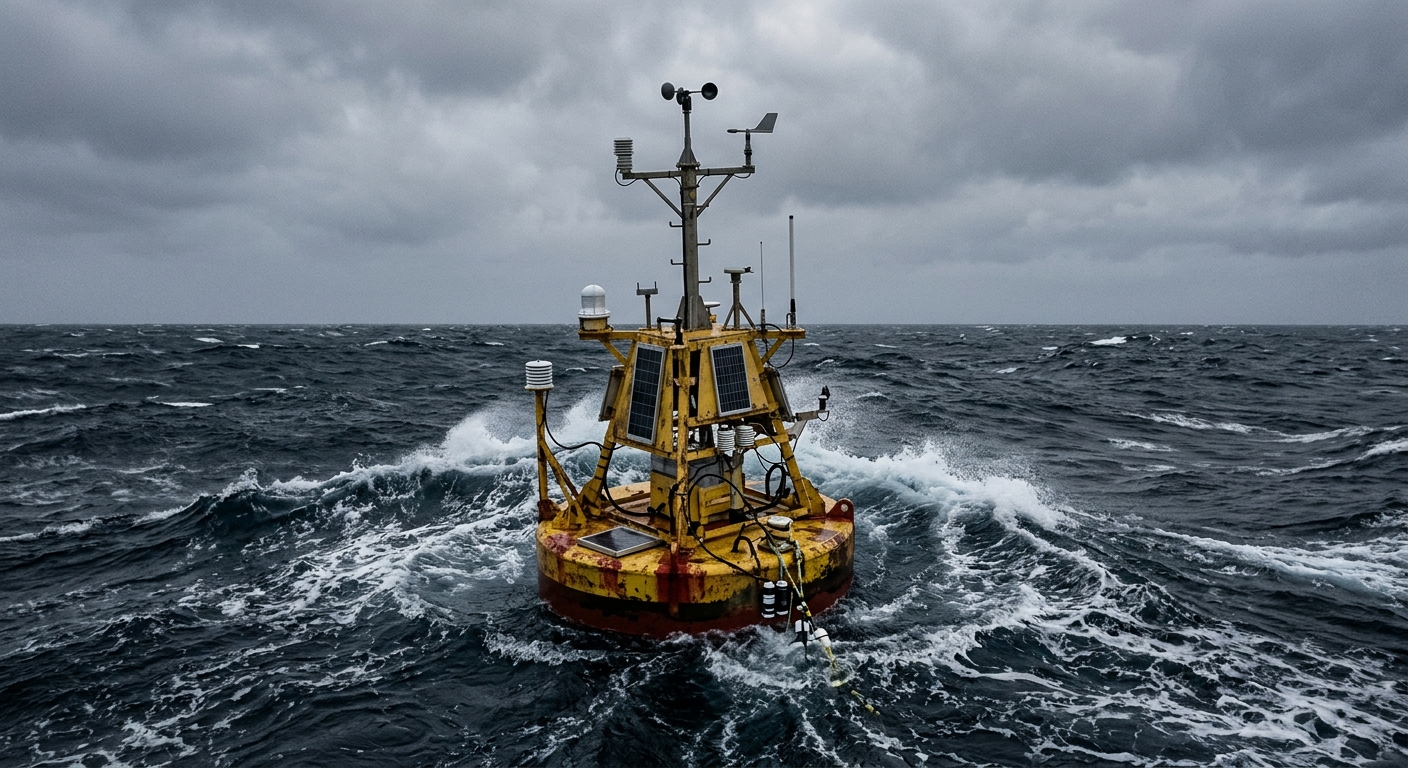
AI-generated illustration; not a photograph of the reported event.
- calendar_today June 4, 2026
ALASKA — The planned decommissioning of Ocean Station Papa by the National Science Foundation (NSF) has sparked significant concern in Alaska’s scientific and fisheries communities, as the region braces for the loss of a foundational ocean observation station in the Gulf of Alaska. The move, part of a sweeping shift in federal science priorities, threatens to curtail access to decades of crucial ocean data that have supported climate and marine ecosystem studies in the North Pacific.
Decades of Ocean Monitoring at Risk
Located more than 2.5 miles beneath the surface in the Gulf of Alaska, Ocean Station Papa’s network of sensor-equipped moorings has been a pillar of marine observation since the Cold War. The station’s high-resolution recording capabilities provide a continuous stream of information on variables such as ocean temperature, salinity, pressure, and nutrient distribution—data vital to understanding shifting ocean conditions and supporting regional environmental monitoring efforts.
Key Role in Studying Marine Heatwaves
Researchers have relied on the long-term records from Ocean Station Papa to chart the development and impact of significant marine heatwaves, including the widely studied 2014–2016 “blob” event. This anomalous warm-water period had widespread effects on the marine ecosystem, dramatically disrupting fish populations and other marine wildlife. Access to robust ocean data from the station allowed Alaskan scientists and the broader research community to track the event’s progression and assess its biological impact.
Expert Concerns about Fisheries and Ecosystem Research
Marine scientists from the University of Alaska Fairbanks and other institutions stress that discontinuing operations at Ocean Station Papa will hinder their ability to study and respond to ocean warming events. The station’s comprehensive sensor suite, including advanced ocean sensors, enables detailed monitoring of key environmental factors. Without this data, local researchers fear essential fisheries management and climate adaption strategies may suffer, especially as the Gulf continues to experience ecological shifts tied to climate change.
NSF’s Strategic Shift and Remaining Observation Efforts
The NSF stated that the removal of Ocean Station Papa represents a reprioritization within the broader Ocean Observatories Initiative, rather than an outright cancellation of ocean monitoring in the region. While the National Oceanic and Atmospheric Administration (NOAA) will maintain its surface ocean climate station at the site, the fate of ongoing deep-water monitoring—regarded as unique within global scientific programs—remains undecided.
Implications for Alaska’s Science and Marine Industries
The uncertainty has sparked debate among Alaska’s academic, resource management, and commercial fishing stakeholders, who recognize the critical link between sustained environmental monitoring and the state’s ability to manage its valuable marine resources. The prospect of losing continuous, long-term ocean observation from Ocean Station Papa has underscored the broader importance of strategic federal investment in scientific infrastructure—particularly as Alaska’s fisheries management agencies rely on comprehensive data to guide sustainable policy decisions.
Looking Ahead: The Value of Ocean Data in a Changing Climate
As the Gulf of Alaska remains a hotspot for climate-related ocean changes, scientists urge decision-makers to consider both the local and global importance of uninterrupted, high-quality ocean observation. The robust historical and real-time ocean data provided by Ocean Station Papa has proven invaluable in tracking emerging environmental threats. Its removal is expected to leave a gap in the region’s capability to monitor trends, study future marine heatwaves, and understand the evolving dynamics of the marine ecosystem. Alaska’s role in global climate science will be shaped in part by the continued availability—or lack—of such cornerstone research infrastructure.


