
- calendar_today August 14, 2025
.
The prospects for electric vehicles (EVs) in the United States are getting a second look. The lackluster market performance over the last year is raising questions about the near-term electric transition. After more than a year of month-over-month increases, EV sales have contracted for the first time. Consumers are already turning away from EVs at Genesis and Volvo and both brands are reportedly reconsidering their electric lineups.
The political and regulatory environment is hardly a help, with the Biden administration having just rescinded vehicle pollution standards and reduced subsidy levels. The result is fewer carrots from Washington to drive new EV sales. But industry analysts and researchers say the real challenge may be much closer to home.
Range anxiety is as American as the garage
EV range anxiety is nothing new. The lack of public charging infrastructure has dogged the segment for over a decade. Consumer surveys have consistently found it to be the single biggest issue standing in the way of potential EV buyers.
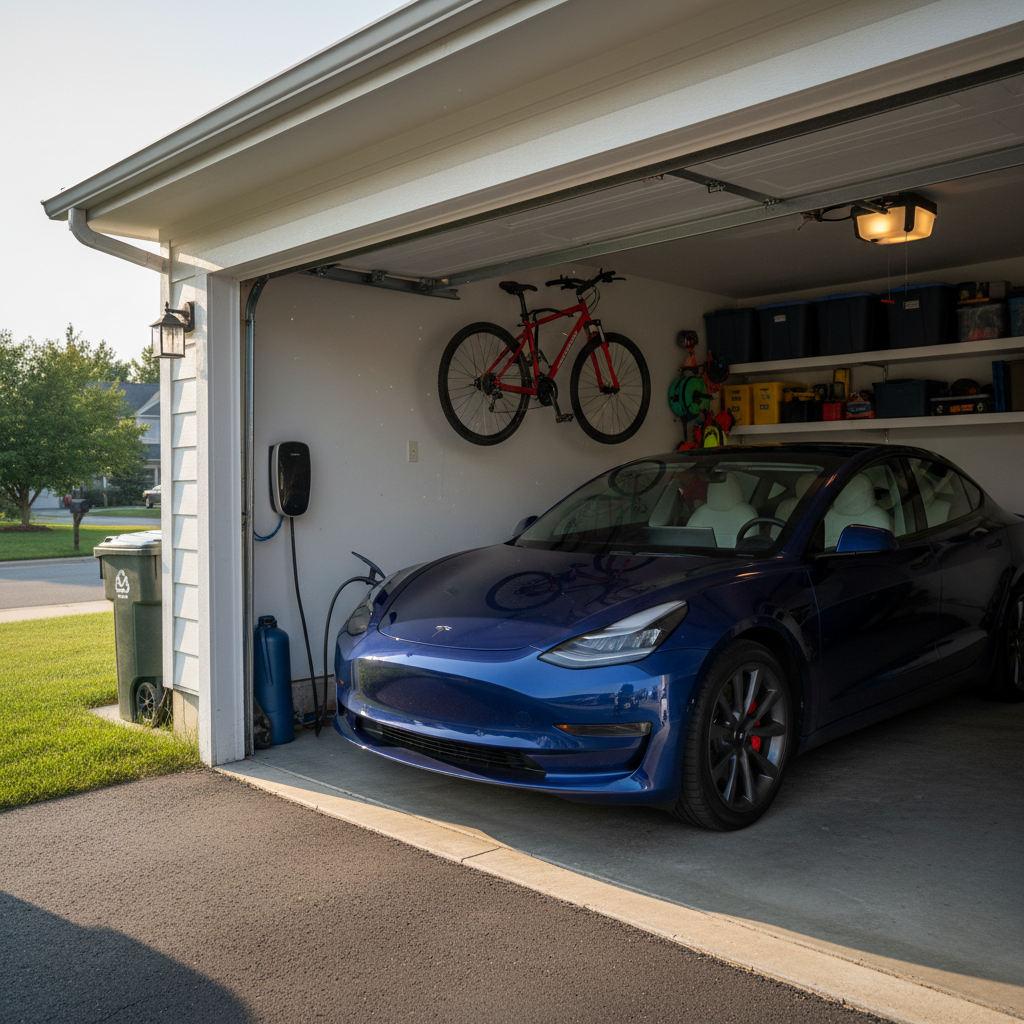
New research from Telemetry Vice President Sam Abuelsamid focuses on an often overlooked aspect of that range anxiety: home garage usage. While coverage of fast-charging infrastructure may grab most of the headlines, the vast majority of charging takes place at home. Research firm CoPilot estimated that 80 percent of all EV charging is done using AC power. A single-family residence is where the most is happening.
Data from the National Renewable Energy Laboratory (NREL) found that 42 percent of homeowners already had space at their house to park a vehicle within reach of an outlet supporting level 2 (240-volt) charging.
Abuelsamid projects that number to increase “substantially” to 68 percent of homes if changes were made to garage clutter and parking behavior. “90 percent of all houses can add a 240 V outlet near where cars could be parked, although parking behavior, namely whether homeowners use a private garage for parking or storage, will likely become a key factor in EV adoption,” he said.
Parking a vehicle rather than boxes of holiday decorations in garages would increase the share of homes capable of EV charging from 31 million to more than 50 million. Adding in the homes where new wiring could be added would take that number to more than 72 million. Even that exceeds Telemetry’s most bullish EV penetration forecast for 2035 of between 33 million and 57 million vehicles.
On paper, the prospects for the U.S. residential garage seem very positive for EV adoption. The gap between current charger penetration and “optimal” potential is substantial. The NREL study Abuelsamid referenced found that nearly 34 million American homes would require some level of electrical upgrade to support a level 2 charger. The amount of power required for level 2 charging has doubled over the past two decades, and a new installation typically requires at least 30 amps of power. These electrical upgrades could range from running new wiring to an entire distribution panel replacement. The costs to the homeowner can be in the thousands of dollars.
Add the cost of charger installation to the purchase price and the EV cost of ownership advantage over the long term can begin to diminish. For comparison, a new 2024 Toyota Camry starts under $24,000. An extra-home outlet and electrical upgrade could cost in the same ballpark.
The hardest hit by these issues will be the 23 percent of American households living in multifamily dwellings, including apartments, condos, townhomes, and co-ops. In these cases, the individual EV owner has less control over installing new charging, instead having to seek approval from landlords, management companies, or co-op boards. Such approvals are not guaranteed, and in many cases, complex electrical work may be needed to retrofit existing buildings. These upgrades, such as new wiring or panel replacements, are very expensive and may cost millions of dollars for a co-op, for example. Wiring existing units to distant parking spaces add to the cost.
While new buildings are generally required to install at least one level 2 outlet per parking space, there are generally no mandates for wiring the existing homes. That means residents in these buildings are often left out of municipal or utility rebates and subsidies for charger installation.
Today, there are about one million EV owners living in multifamily housing. The typical garageless American city dweller faces multiple barriers to charging their EV, both in terms of range anxiety as well as cost and convenience. That fact is reflected in the NREL study, which found that only 11 percent of multifamily EV owners park close enough to an outlet to charge.
Some states have mandates for new housing developments to have 20–25 percent of spaces EV-ready. This has helped drive the total number of EV-ready spaces in multifamily dwellings up to just under one million. Telemetry estimates that over time it could grow to between 6.7 million and 11.4 million charging-capable spaces in multifamily dwellings by 2035, but that still may not be enough.
Plug-in public charging on deck
EVs have historically relied less on public charging in the U.S. than in Europe or China, but given home range anxiety, that is changing. The Telemetry study on optimal U.S. charging capacity found that despite homes with adequate charging capability exceeding 100 million, about 11.7 million to 14.3 million EV drivers who own a home would still need to use public charging by 2035. Another 7.8 million to 8.1 million EV drivers living in multifamily homes are also projected to rely on public charging.
To fill that gap will require significant new infrastructure: between 523,000 and 586,000 DC fast chargers (DCFC), plus another 1.5 million to 1.6 million level 2 chargers nationwide. The problem is power companies are already feeling a strain on their networks trying to add new generation, and there is a new competitor in town for the existing distribution assets: the AI data centers.
EVs are booming in countries like Norway, China, and India. The U.S. market is in more of a holding pattern as the long-term transition to electrification is put to the test. If history is a guide, every home or apartment could technically be an EV-ready place to park and plug in. The reality is a more complex blend of garage clutter, high electricity upgrade costs, and the multi-unit housing conundrum, all of which threaten to dampen the pace of EV adoption in the coming years. The coming surge of public charging expansion in the U.S. will be sorely needed, but could still be outpaced by demand.


