- calendar_today August 12, 2025
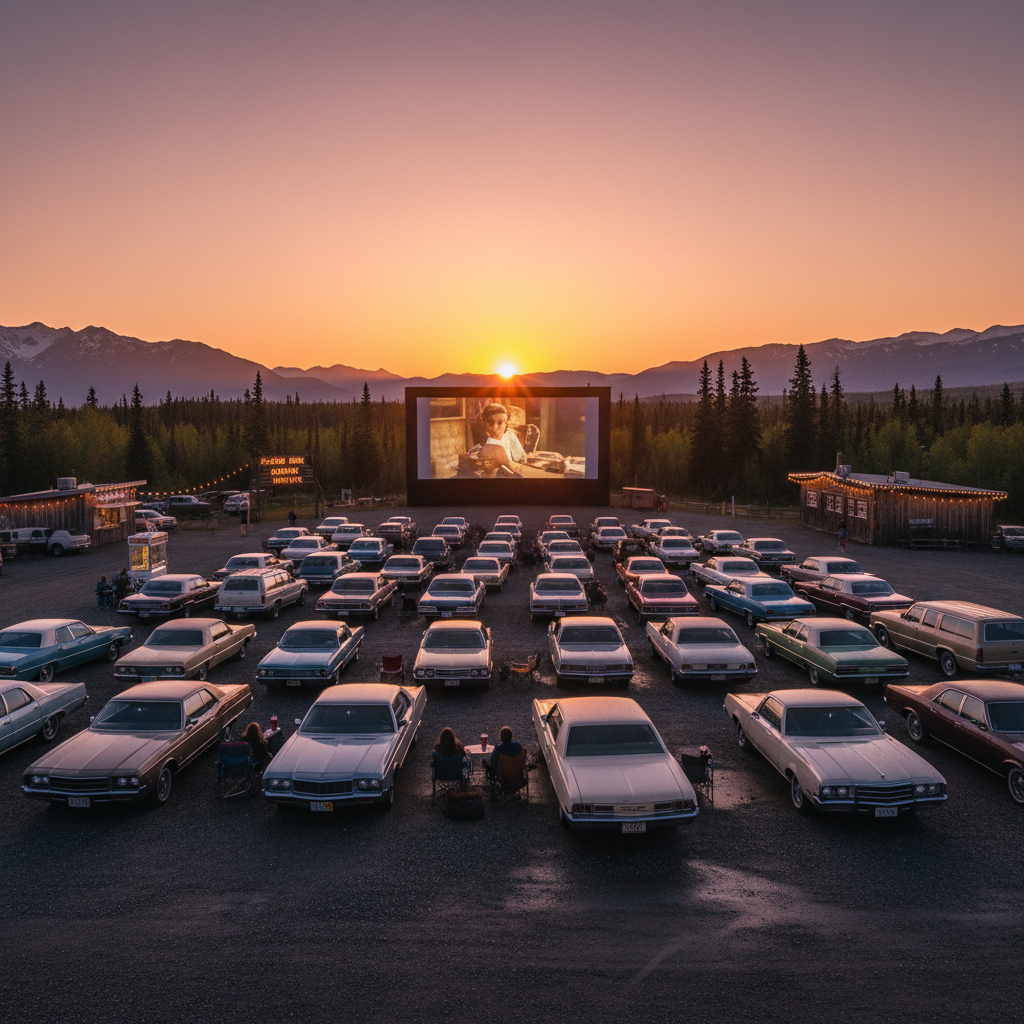
ANCHORAGE — The sun never really sets here. It dips, lingers, glows again — a half-light that makes night feel like a suggestion. Against that endless horizon, a glowing screen flickers to life. A few dozen cars line the gravel lot. Windows crack open. The smell of popcorn mixes with spruce and diesel. And just like that, Alaska’s drive-in tradition — long buried beneath snow and time — has returned.
For the first time in decades, movie nights are happening under the midnight sun. Not in multiplexes or streaming queues, but out in the open, in the sharp, blue-gold light that never fully leaves.
Reel Stories in the Land of Endless Sky
Across the state, from Fairbanks to Juneau, Anchorage to Kenai, makeshift screens rise in unexpected places — school parking lots, old airstrips, quiet baysides. The organizers aren’t corporations or big investors. They’re teachers, rangers, and families who decided it was time to gather again.
At the Aurora Drive-In near Wasilla, a group of volunteers built the screen from reclaimed lumber and metal siding. “We thought we’d do one weekend,” says founder Kara Holm, laughing as she hands out cocoa from a thermos. “But now it’s every week. Nobody wants to stop.”
People arrive wrapped in parkas and flannel. Some sit in pickup beds layered with blankets; others unfold camp chairs beside propane heaters. The air crackles with quiet chatter and the occasional bark of a husky. Even in the chill, there’s warmth — the kind that comes from people simply being together again.
Life Between Light and Silence
Movies hit differently here. Under the endless twilight, the line between screen and sky feels thin. A scene from an old western fades into the soft shimmer of clouds. A child’s laughter carries across the lot, clear and echoing.
The drive-in becomes more than an event; it’s an echo of Alaskan life itself — raw, self-sufficient, and stitched together by small acts of courage.
“There’s something grounding about it,” says local filmmaker Jesse Monroe. “You’re surrounded by silence, wilderness, and strangers — but somehow it feels like home.”
As the movie plays, fog creeps in from the inlet. The screen glows through it like a lantern. People sip from steaming cups, the air full of woodsmoke and breath. Somewhere, a raven calls. Nobody moves. Nobody wants to break the spell.
Retro Spirit, Northern Heart
Alaska’s new drive-ins blend old soul with frontier resilience. Instead of soda fountains and neon lights, there are wood stoves, soup stands, and hand-painted signs. Instead of hamburgers, you’ll find salmon sliders, reindeer sausage, and hot chocolate so thick it coats the lid.
FM radios buzz softly. The sound quality isn’t perfect, but that’s part of the charm. These are gatherings that embrace imperfection — proof that warmth doesn’t require polish.
There’s even a pre-show tradition forming: short films made by local students or park rangers, telling stories about fishing, hiking, and the northern lights. The audience cheers just as loudly for those as for the feature film.
When the Show Ends
The credits roll. The horizon glows pale orange, refusing to darken. Cars hum to life one by one, headlights flashing briefly against the still air. But most people don’t leave right away. They linger — hands resting on steering wheels, eyes still fixed on the screen.
There’s no rush here, no honking, no city noise. Just a quiet understanding: nights like this are rare. The film might end, but the feeling — that small flicker of belonging — stays long after.
By the time the last truck pulls away, the sky has shifted again, the faintest blush of dawn touching the peaks. Another Alaskan night has passed without ever turning dark.
And somewhere between the fading light and the lingering silence, Alaska remembers what it means to gather — not out of habit, but out of heart.
Because here, beneath the northern sky, cinema isn’t about escape. It’s about staying — in the cold, in the quiet, together.