
- calendar_today August 20, 2025
.
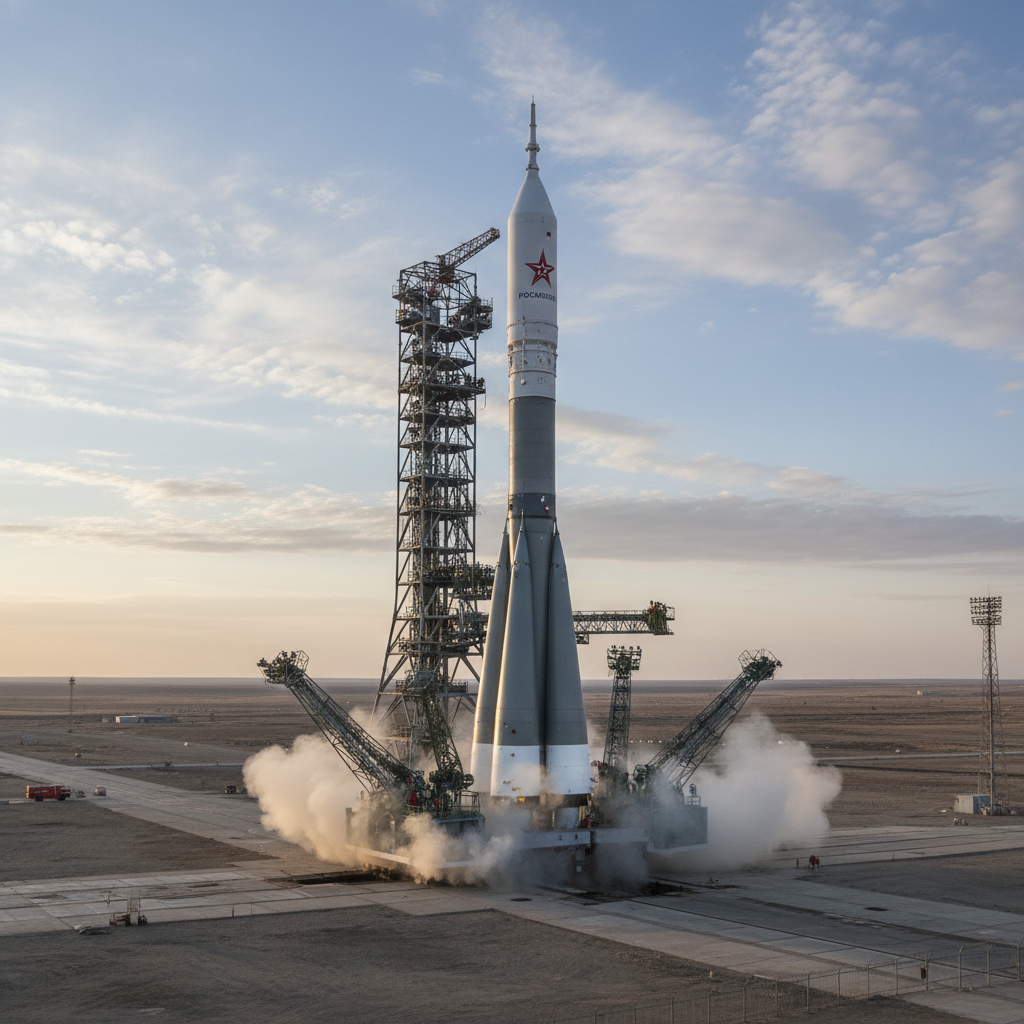
Russia is gearing up to launch a new rocket late this year, Roscosmos head Dmitry Bakanov has announced. Called Soyuz-5, the vehicle will fly for the first time before the end of December, Bakanov told state-owned media agency TASS.
“Yes, we are planning for December,” he said in the interview. He added that preparations for the initial liftoff are in the final stage, and Soyuz-5 will take to the skies from the Baikonur cosmodrome in Kazakhstan. If successful, this will mark the vehicle’s maiden test flight. It has been under development for more than a decade, and Roscosmos expects to conduct several trial launches before it enters operational service. That milestone, however, is not expected before 2028.
The rocket does not represent a complete departure from existing concepts. In fact, Soyuz-5, also known by its codename Irtysh, owes much of its design to the Zenit-2 rocket, a vehicle first developed in the 1980s by the Yuzhnoye Design Bureau in Ukraine. While Zenit vehicles were assembled in Ukraine, their engines were built in Russia under a contract for the powerful RD-171 first-stage engine. This was a rare example of continued Russian-Ukrainian cooperation after the Soviet collapse, one that has all but ended after Russia’s invasion of Ukraine in 2022. In December 2023, a Russian missile strike hit the Ukrainian plant where Zenit rockets had been assembled.
Soyuz-5 is thus a larger version of the Zenit, but built entirely in Russia instead. Replacing Ukraine in its supply chain is a major goal for Moscow. It puts an end to a longstanding reliance on its former Soviet neighbor while also marking the end of the decades-old Proton-M launcher.
A Step Back, Two Steps Forward
Although called Soyuz-5, the rocket belongs in the medium-lift segment. It can haul about 17 metric tons to low-Earth orbit. This payload capability is achieved with slightly larger propellant tanks than those on the Zenit. But more importantly, Soyuz-5 is powered by the RD-171MV engine at its core, the latest iteration of a Russian classic.
The design can trace its heritage to the Energia program of the 1980s. Energia was the Soviet space shuttle program, with Buran being its prototype orbiter. The RD-171MV, by contrast, is an expendable rocket engine, used to power Soyuz-5. It is notable for a reason: it is made in Russia and uses no Ukrainian parts. The engine burns a mixture of kerosene and liquid oxygen and can produce more than three times the thrust of NASA’s Space Shuttle main engine. No other operational liquid-fueled rocket engine is more powerful.
But while the engine is impressive, the rocket is not designed to be reused. It is, in other words, a direct competitor to NewSpace entrants such as SpaceX. The difference in philosophy places strong doubts over whether Soyuz-5 can capture any meaningful share of the global launch market.
That said, Soyuz-5 has an important role to play within Russia’s own space program. With budgetary constraints and sanctions hampering new development, building a brand-new, reusable rocket has proven difficult. The Amur project, also known as Soyuz-7, was Russia’s answer to that question. It, too, would have been called Soyuz, but with a reusable first stage and methane-fueled engines, Amur is a rocket for the future. Its technology, some of which was demonstrated as early as 2019, could help Roscosmos challenge SpaceX on cost. In practice, though, development was far slower than expected. The project’s maiden flight has been pushed back to 2030 at the earliest.
Until then, Russia has Soyuz-5. It will not move the country’s space program into the future, but it will take it into the present, one that is being defined by a decade-old political conflict. As such, it is more a bridge between the Soviet past and an uncertain future than a step in a particular direction.
The commercial side of that future, however, is not yet clear. The international launch industry has transformed over the past decade with the emergence of SpaceX and Chinese competitors, both of which have undercut prices and created a flexible secondary market. Russia still launches Soyuz-2 rockets for crewed missions and Angara rockets for heavier payloads. But the Angara launch vehicle, too, has never been a major international success story.
Whether Soyuz-5 will find a meaningful share of this market is uncertain. It is also worth noting that Roscosmos had already managed to bring Soyuz-5 close to initial launch despite all these external factors. It is an achievement in its own right, and a successful flight in December would mark the point when Russia could put new rocket hardware on the pad in spite of foreign sanctions and internal budget cuts.
The new Soyuz-5 rocket may not be revolutionary. But in Russia, it has political and industrial significance. The rocket will help pave the way for what comes next, be it the Amur project or a new generation of Russian launch vehicles.


