- calendar_today August 16, 2025
.
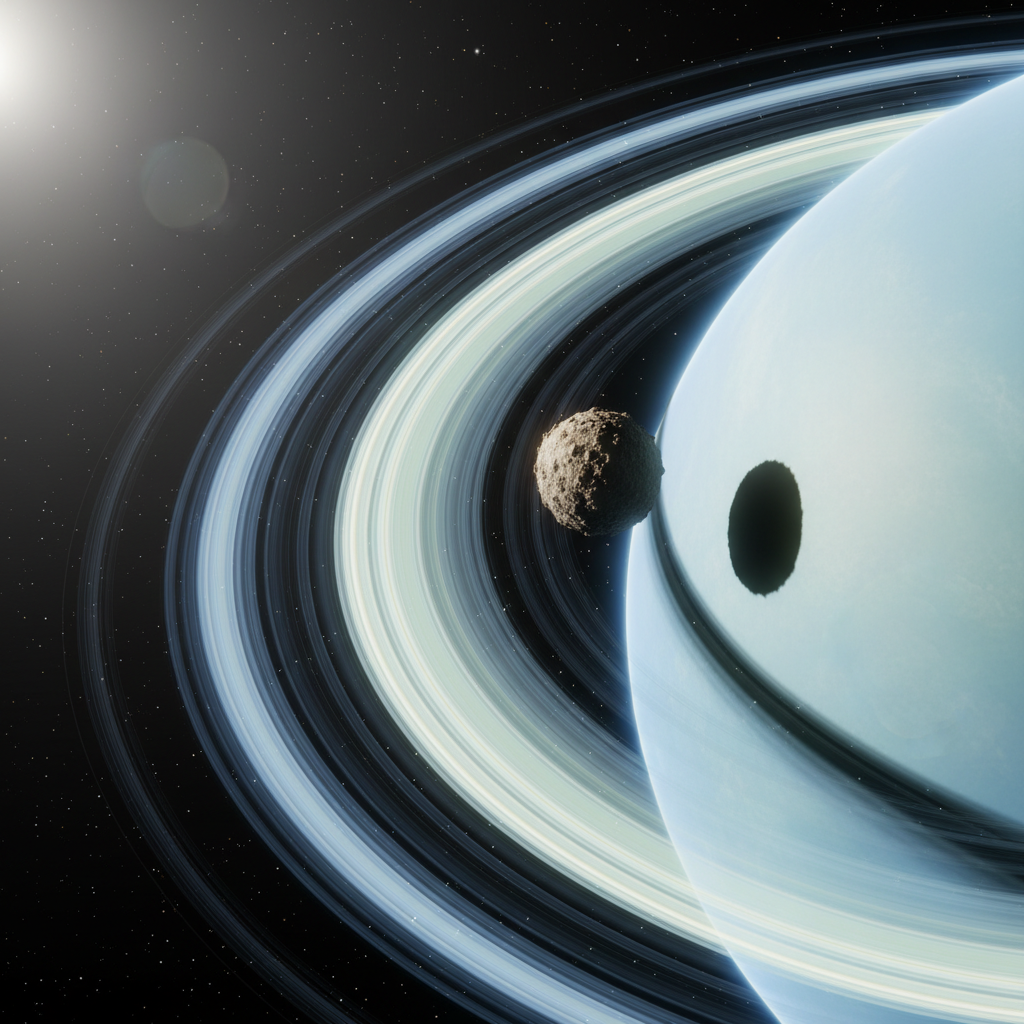
Images from NASA’s James Webb Space Telescope have revealed a small, previously undiscovered moon around the ringed ice giant Uranus. The discovery brings the known total of Uranus’ moons to 29, and researchers suspect there are more waiting to be found.
Webb revealed the elusive object on Feb. 2 through a series of 40-minute long-exposure images taken by the telescope’s Near-Infrared Camera. The newfound moon measures just 6 miles (10 km) across, making it one of Uranus’ smallest natural satellites ever discovered. The moon’s diminutive size and the bright light from Uranus’ rings probably hid the moon from earlier spacecraft and ground-based telescopes. It may even have been too small to see from up close by NASA’s Voyager 2 spacecraft, which flew by Uranus nearly 40 years ago.
“This is a small moon but a significant discovery,” said Maryame El Moutamid, lead scientist at the Southwest Research Institute’s Solar System Science and Exploration Division in Boulder, Colorado, and principal investigator (PI) of a Webb program to study Uranus’ rings and inner moons. “This really highlights the science that Webb can do, going far beyond what was known from previous missions.”
The newly discovered moon has been temporarily named S/2025 U1, and it orbits Uranus’ equator about 35,000 miles (56,000 km) from the planet’s center. S/2025 U1 moves in a nearly circular path in the plane of Uranus’ equator, nestled between two of the planet’s known moons: Ophelia, just beyond Uranus’ bright main ring system, and Bianca. The new moon’s orbit suggests it may have formed near where it is now.
The moon was tough to tease apart from the glare of Uranus and its rings because it’s dark, tiny, and fast-moving. That’s where Webb’s sensitivity to faint infrared light came in handy. The $10 billion infrared observatory has already given astronomers a peek at the rings, weather, and upper atmosphere of Uranus, and this discovery adds to that growing record.
A Uranian Moon Mystery Revealed
The discovery of the new moon may also shed light on how Uranus’ complex ring system formed. Scientists suspect that the newly discovered S/2025 U1 and some of Uranus’ rings may share a common origin, perhaps a fragmentation from a single event long ago. “The discovery raises questions about how many more small moons remain hidden around Uranus and how they interact with the planet’s rings,” El Moutamid said.
Uranus has five major moons: Miranda, Ariel, Umbriel, Titania, and Oberon. They’re all larger and orbit farther out from Uranus’ equator than the ringed world’s collection of much smaller moons. The newly discovered body is the 14th member of that inner system. Uranus is unique in that no other planet in the solar system has as many small, inner moons so close to each other in the sky. Astronomers aren’t sure how these satellites remain stable; they orbit so close that their paths cross, yet they somehow avoid collisions. The satellites may act as shepherds, keeping Uranus’ narrow rings in check.
“This is very exciting, and I congratulate the team on their discovery,” said Scott Sheppard, an astronomer at the Carnegie Institution for Science who was not involved in the new study but co-discovered a Uranus moon in 2024. “This object is especially interesting because of its very close association with Uranus’ inner ring system. Amazingly, Webb was able to detect it given how small and faint it is.”
“We now know that there is no clear dividing line between what is considered a moon and what is a ring, with some objects like this one providing an intriguing and perplexing bridge between the two populations,” said SETI Institute scientist Matthew Tiscareno, co-principal investigator in the Webb Uranus project.
Tiscareno and other members of the Uranus ring-moon system team published a study in the journal Icarus in January on inner moons so small and faint that they can blend in with Uranus’ ring system, including two moons detected with Hubble Space Telescope images. The newly discovered moon is even smaller and fainter than the smallest known Uranian inner moons, Tiscareno said, suggesting that more still await discovery.
The recent find from Webb is not the first moon to come to light around Uranus. Voyager 2 was the first spacecraft to provide detailed images of Uranus, making 10 additional moon discoveries, which ranged in size from 16 to 96 miles (26 to 154 km) in diameter, during its pass by the planet in 1986. Astronomers had previously only spotted Uranus’ five largest moons, with the earliest discoveries dating as far back as 1787. After Voyager, it was left to ground-based telescopes and Hubble to uncover 13 more small moons that range from 8 to 10 miles (12 to 16 km) across. Unlike the largest Uranian moons, which have icy surfaces, these are all very dark, even darker than asphalt. The smaller, inner moons are likely a mix of ice and rock, while the four outer moons beyond Oberon are thought to be captured asteroids.
The future is bright for Uranus exploration. A planetary decadal survey released by the National Academies of Sciences, Engineering, and Medicine in 2022 recommended that NASA’s next big planetary mission should be a Uranus Orbiter and Probe spacecraft. The recommended mission, should it be given the green light, could launch in the early 2030s, though its funding is still up in the air as NASA wrestles with its budget during the current continuing resolution. A Uranus mission would help solve many of the planet’s mysteries, from its tilted axis of rotation to its baffling magnetic field to the atmospheric dynamics to perhaps icy ocean worlds among its moons.
Sheppard, who’s been on the hunt for new moons around the outer planets for three decades, says there are undoubtedly more moons as small as a few kilometers across waiting to be discovered, either with long-exposure images like the ones from Webb or up close with a spacecraft. “The trick is finding them,” he said. “We’re out there.”
In addition to refining the new moon’s orbit, El Moutamid and her team plan to continue to look for new, hidden moons in long-exposure Webb images.
“Discovering a new moon around Uranus is exciting because it helps scientists better understand how its strange system formed and also sheds new light on its rings,” El Moutamid said. “It’s also a precursor for future missions coming to Uranus, like NASA’s Uranus Orbiter and Probe mission.”